
What happened in housing and the economy this week, explained in plain English so you can talk about it with confidence.
Freddie Mac weekly avg. 7.28%, up from 7.11%
About 91% odds of a quarter-point hike on Dec. 9
46% of home builders are cutting prices
Inflation and the Fed are keeping rates near 7.5%, and markets fully expect another increase on December 9. At the same time, slow sales are pushing sellers and builders to offer price cuts, closing-cost help and rate buydowns. In this market, the terms of the deal can matter as much as the rate.
This week's mortgage rates
| Loan type | Rate | Change this week | 52-week low | 52-week high |
|---|---|---|---|---|
| 30-Year Fixed | 7.46% | +0.16 | 5.99% | 7.61% |
| 15-Year Fixed | 6.98% | +0.06 | 5.55% | 7.23% |
| 30-Year FHA | 7.04% | +0.15 | 5.62% | 7.25% |
| 30-Year VA | 7.06% | +0.16 | 5.64% | 7.25% |
| 30-Year Jumbo | 7.50% | +0.10 | 6.26% | 7.71% |
| 7/6 SOFR ARM | 7.07% | +0.27 | 5.29% | 7.13% |
Source: Mortgage News Daily rate index as of 11/18/2026, based on a top-tier borrower (75% loan-to-value, 780 credit score) and adjusted for points. These are market averages, not rate offers.
Where the 30-year fixed has been
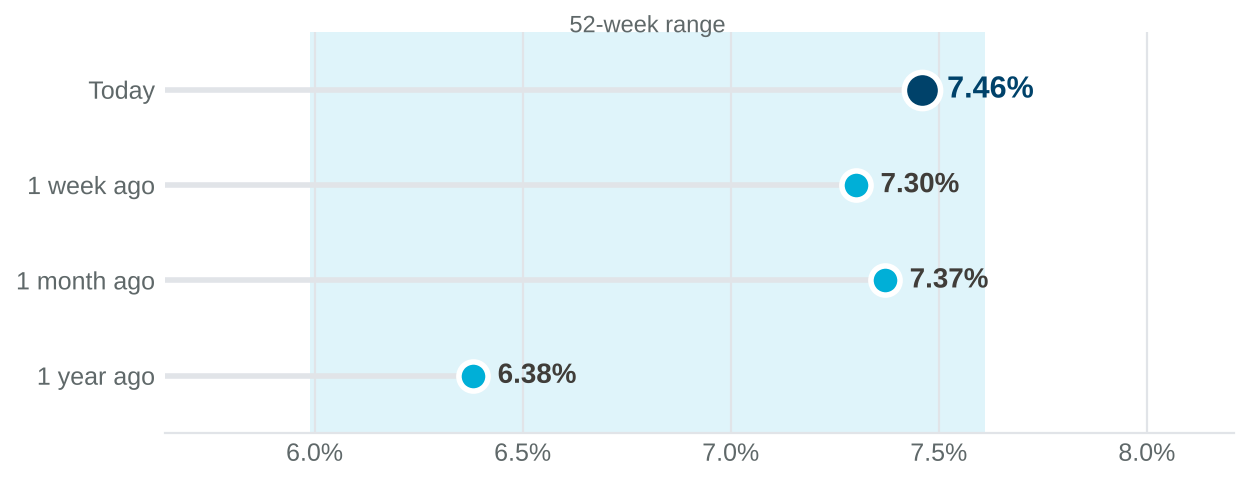
Source: Mortgage News Daily 30-year fixed index, 11/18/2026. Shaded band = 52-week range.
Most rates are near the top of their one-year range. Government-backed FHA and VA loans are pricing about 0.4% below the standard 30-year fixed, and the adjustable-rate (ARM) discount has nearly disappeared. The 30-year fixed is about 1.1% higher than a year ago.
This week's reports at a glance
Change from the prior month, in percent
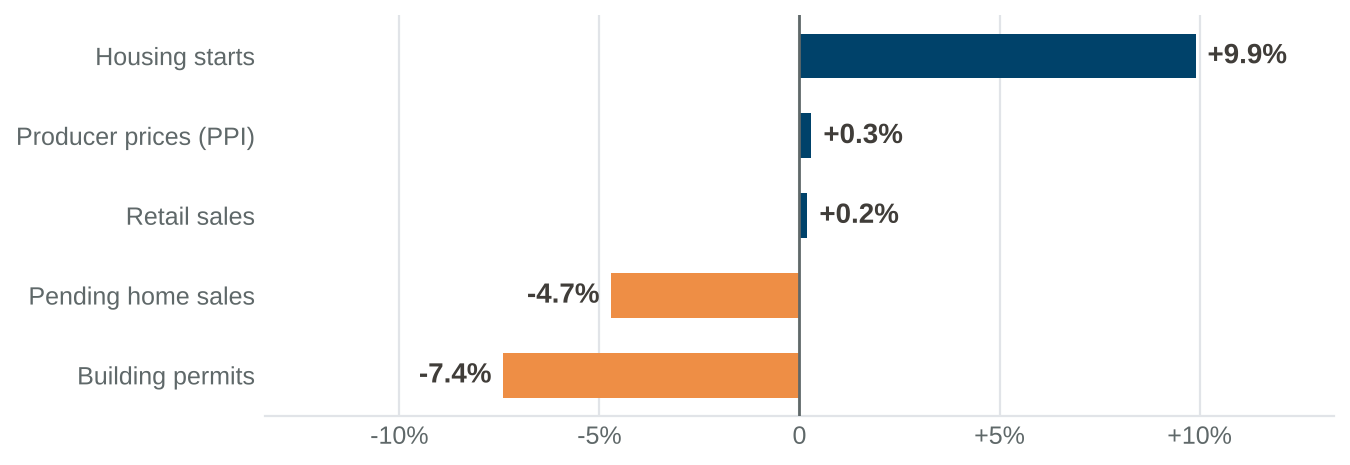
Sources: Census Bureau, Bureau of Labor Statistics, NAR. October data released Nov 13–18, 2026.
What happened, explained
Each story gives you the facts, a quick lesson on why it matters, and a simple way to say it in conversation.
Rates gave back October's improvement
What happened: Freddie Mac's weekly survey, released Thursday, showed the 30-year fixed averaging 7.28%, up from 7.11% last week and 6.26% a year ago; the 15-year rose to 6.66% from 6.45%. The daily index climbed 0.32% over three days to 7.50% last Friday, then eased to 7.46% by Wednesday. The 10-year Treasury yield, which mortgage rates tend to follow, rose to about 5.16% before slipping back to about 5.05% on Thursday after softer job and factory data.
Mortgage rates move with the 10-year Treasury yield, not directly with the Fed. Investors compare mortgage bonds with Treasuries, so when Treasury yields rise on inflation worries, mortgage rates usually follow within days.
"Freddie Mac's weekly average jumped to 7.28% this week because the 10-year Treasury spiked on inflation worries. Daily rates have eased a little since Friday, but they're still near the top of their one-year range."
The Fed is expected to raise rates again on December 9
What happened: Minutes from the Fed's October meeting showed almost all officials expect further rate increases, and Governor Waller again argued for a half-point hike. As of Thursday, markets put about a 91% chance on a quarter-point increase on December 9 and about a 9% chance of a half-point move, up from roughly 6.5% a day earlier. No one is betting on the Fed holding steady.
What markets expect on December 9
Odds of each outcome, CME FedWatch
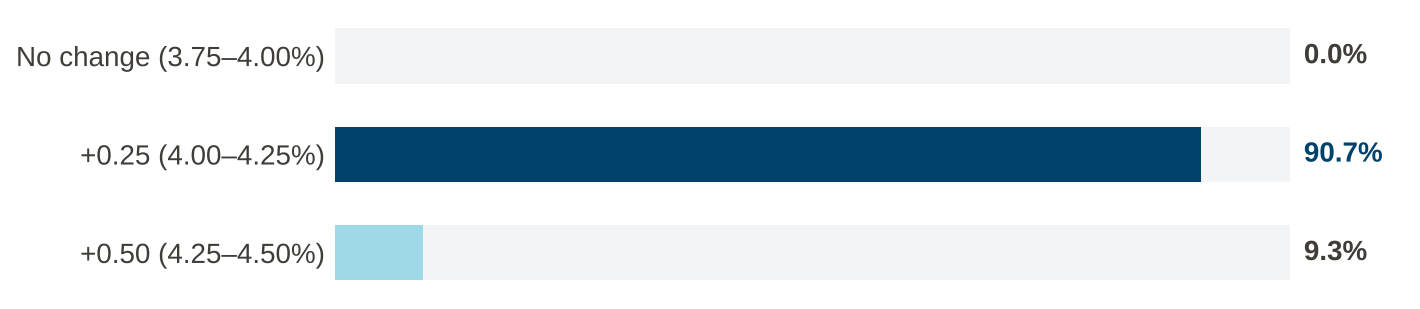
Source: CME FedWatch as reported 11/19/2026 (via news coverage).
The Fed sets the short-term rate banks charge each other overnight. That flows straight into credit cards, HELOCs and adjustable-rate loans. Fixed mortgage rates react more to what the Fed signals about future inflation. The odds come from the CME FedWatch tool, which reads what traders are betting on.
"The Fed doesn't set mortgage rates, but it sets the tone. Markets see a December 9 rate hike as close to certain, which keeps pressure on rates for now."
Wholesale prices rose less than expected, but inflation is still hot
What happened: The Producer Price Index (PPI) rose 0.3% in October, slightly below the 0.4% forecast and well below September's 1.4% jump. Over the past 12 months, though, wholesale prices are up 6.5%, the highest annual rate since November 2022.
The PPI tracks the prices businesses receive for their goods and services. It's an early warning for consumer prices, because businesses tend to pass higher costs along. High inflation is the main reason the Fed keeps raising rates.
"Monthly inflation came in a little cooler than expected, but prices are still up 6.5% from a year ago. That's why the Fed isn't ready to back off yet."
Shoppers slowed down but are still spending
What happened: Retail sales grew 0.2% in October, right in line with forecasts, as shoppers pulled back on cars and furniture. The "control group," which strips out volatile categories, rose a healthier 0.6%.
Consumer spending drives about two-thirds of the U.S. economy. When people keep spending, the economy stays strong enough for the Fed to keep raising rates without fear of tipping it into a recession.
"People are still spending, which tells the Fed the economy can handle another rate increase."
Layoffs are still low, but the job market is cooling at the edges
What happened: First-time jobless claims rose by 1,000 to 203,000 last week, above the 197,000 economists expected and the highest since early September. Continuing claims climbed to 1.763 million, a sign it's taking longer for laid-off workers to find new jobs. Separately, the Philadelphia Fed's factory index fell to 6.3 from 20.9, a six-month low, with new orders slipping below zero.
Jobless claims count people filing for unemployment for the first time each week, so they're the fastest read on layoffs. Under about 250,000 is considered healthy. A softer job market is one of the few things that could make the Fed slow down its rate hikes.
"Layoffs are still low, but it's taking people longer to find new jobs. If that keeps up, it's one of the things that could eventually ease pressure on rates."
Signed contracts hit a second straight record low
What happened: Pending home sales fell 4.7% in October, worse than the 2.0% drop expected, to a second straight record low. They're down 16.7% from a year ago, with declines in all four regions. On the bright side, NAR chief economist Lawrence Yun says October may mark the bottom now that rates appear to have peaked.
A pending sale is a signed contract that hasn't closed yet. Because closings usually happen one to two months after signing, pending sales are a preview of where closed sales are headed.
"Fewer homes went under contract last month than ever recorded. That's tough for sellers, but it means buyers have more room to negotiate."
Builder confidence fell to its lowest level since 2012
What happened: The National Association of Home Builders confidence index dropped to 25 in November from 29. A record post-pandemic 46% of builders cut prices, and 68% offered incentives like rate buydowns. Housing starts jumped 9.9% in October, but the Census Bureau says the gain isn't statistically meaningful. Building permits, a sign of future construction, fell 7.4%.
Builder confidence: 25 out of 100
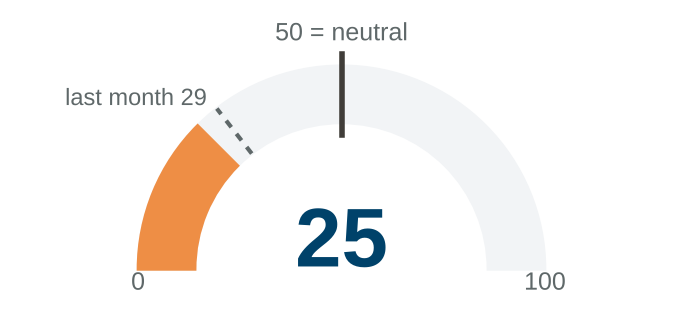
Source: NAHB/Wells Fargo Housing Market Index, November 2026.
The NAHB index runs from 0 to 100. Anything above 50 means more builders see good conditions than poor ones. At 25, builders are discouraged, which is why so many are cutting prices to attract buyers.
"Builders are the most discouraged they've been in 14 years, and almost half are cutting prices. New construction is where some of the best deals are right now."
Where the market stands: the Realtor.com Market Clock
4 o'clock: late balanced, loosening toward buyers
What happened: Realtor.com's quarterly Market Clock places the national market and 99 large metros on a 12-hour dial: seller's markets at the top, buyer's markets at the bottom. The national reading moved to 4 o'clock from 3 o'clock last quarter, and about two-thirds of metros now favor buyers or are moving that way. Seller's markets fell to 27 from 39 a year ago. The catch: rates above 7% have cut a typical buyer's purchasing power by about $22,000.
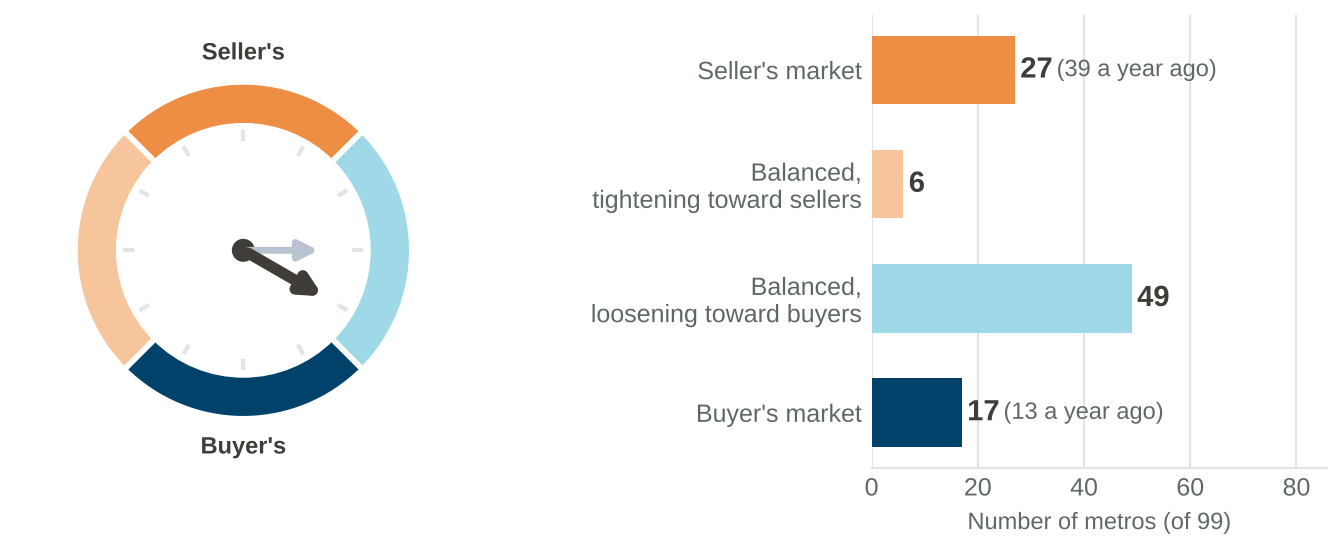
Source: Realtor.com Market Clock report, Oct. 19, 2026 (Q3 data, 99 large metros). Updated quarterly; next reading expected in January.
Think of it like a real clock. Noon is a peak seller's market and 6 o'clock is a peak buyer's market. The hand moves clockwise as conditions shift, so 4 o'clock means the market has passed balanced and is drifting toward buyers.
"Realtor.com's Market Clock just moved to 4 o'clock nationally, which means buyers are gaining leverage in about two-thirds of big markets. Higher rates are the catch, so the deal terms matter more than ever."
Why now: Today's economy is often called "K-shaped": households that own stocks and other investments have seen their wealth climb, while many others are stretched. Housing shows the same split. Inman reported on Nov. 10 that affluent buyers fueled by stock-market gains are snapping up high-end homes while lower-priced homes lag. Many of those buyers are wealthy on paper but show little traditional income, which is exactly who this program is built for.
What it is: Assets for Income lets a borrower qualify based on what they own instead of what they earn. The borrower does not need a job, which makes it a great fit for retirees, and there's no paycheck, tax return or debt-to-income math to work through: if the borrower's eligible assets equal at least 125% of the loan amount, they qualify on assets. And 100% of all eligible assets count, including retirement accounts, regardless of the borrower's age.
Illustration only. 100% of eligible asset balances count toward the requirement, including retirement accounts, regardless of the borrower's age. Credit, down payment and property guidelines still apply.
- Retirees: no job or pension income is required
- Business owners whose tax returns show low income after write-offs
- Buyers between jobs, recently sold a business, or received an inheritance
- High-net-worth buyers who would rather keep their investments than pay cash
- Assets must be documented with recent account statements
- Rates are usually higher than conventional loans
- A down payment is still required
- Credit and property guidelines still apply
"Your client doesn't need a job to qualify. With Assets for Income, if their eligible assets equal 125% of the loan amount, they qualify, and 100% of those assets count, retirement accounts included, regardless of age. It's a great fit for retirees."
Non-QM (non-qualified mortgage) loans do not follow standard agency guidelines. Availability, rates, down payment and documentation requirements vary by program and borrower. Not all borrowers will qualify.
Term of the week: temporary rate buydown
A buydown is money paid up front, often by the seller or builder, to lower the borrower's interest rate. In a "2-1 buydown," the rate is 2% lower in year one and 1% lower in year two, then returns to the full rate. Here's how it compares with a price cut of the same size.
| Scenario · $400,000 loan | Rate | Monthly P&I | Savings |
|---|---|---|---|
| No help from the seller | 7.46% | $2,786 | — |
| $9,500 price cut | 7.46% | $2,720 | $66 less |
| $9,500 2-1 buydown, year 1 | 5.46% | $2,261 | $525 less |
| $9,500 2-1 buydown, year 2 | 6.46% | $2,518 | $268 less |
| 2-1 buydown, year 3 on | 7.46% | $2,786 | — |
Same $9,500 from the seller, monthly savings
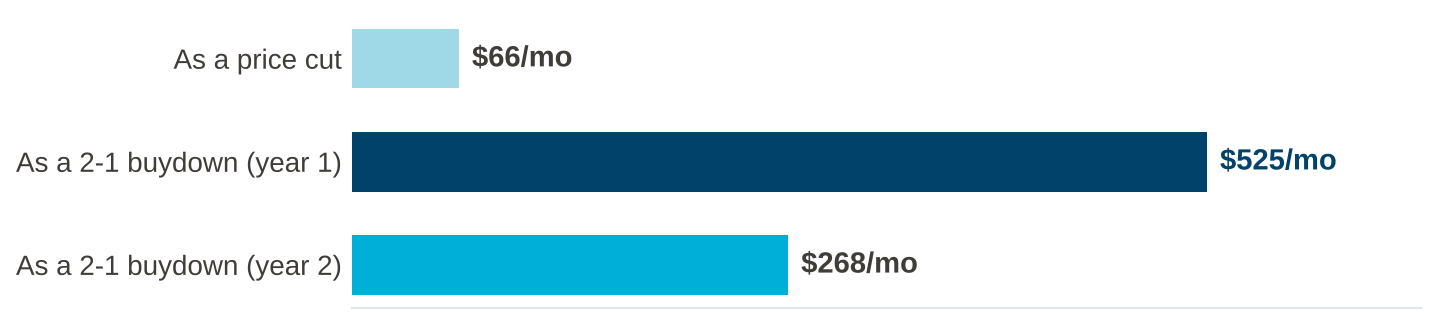
Illustration only, using the 30-year fixed index of 7.46% on 11/18/2026. Price cut assumed to reduce the loan amount dollar for dollar. Principal and interest only; excludes taxes, insurance and mortgage insurance. Not a rate quote or offer to lend.
"The same $9,500 from a seller lowers the payment about $66 a month as a price cut, or about $525 a month in year one as a rate buydown. When payment is the goal, a buydown usually goes further."
Questions you may hear this week
Nobody can promise where rates will go, and the Fed is signaling more increases. What buyers can control today is the price and terms of the home, and right now sellers are more willing to negotiate than they have been in years. If rates fall later, refinancing may be an option.
Mortgage rates respond mostly to inflation and the Fed, not to home sales. Wholesale prices are up 6.5% from a year ago and consumers are still spending, so investors expect the Fed to keep raising rates.
It's moving that way. Realtor.com's Market Clock shows buyers gaining ground nationally, and nearly half of builders are cutting prices. Conditions still vary a lot by neighborhood, so local inventory and days on market tell the real story.
Worth a read
- Mortgage rates average 7.28% · Freddie Mac
- Fed officials expect more rate hikes, minutes show · CNBC
- Homebuilder confidence sinks to a 14-year low as buyers hibernate · HousingWire
- Pending sales down over 16% as 2026 market craters · RISMedia
- New-home buyers are getting lower starting mortgage rates than existing-home buyers · Realtor.com
- Rents edge up for the first time since June 2023 as the construction boom fades · Realtor.com
- Inside the K-shaped housing market: AI millionaires drive luxury sales · Inman
- Real estate AI prompts: 5 for agents to start using right now · Inman
In "Fed Folly," Dr. Elliot Eisenberg argues that raising rates to fight inflation caused by war, tariffs and AI spending only works by squeezing demand, an approach that rarely ends well. Read it at econ70.com
Hosting Thanksgiving? An average 16-pound turkey costs about $23.68 this year, up 10% from 2025, according to the American Farm Bureau Federation's annual dinner survey. Read more
*Communication is intended for Industry Professionals only and not intended for Consumer Distribution
Rates shown are Mortgage News Daily national index values as of 11/18/2026 and are provided for informational purposes only. They are not an advertisement of available terms and are subject to change without notice. Actual interest rate, APR and payment may vary based on the specific terms of the loan selected, verification of information, credit history, the location and type of property, and other factors as determined by Prosperity Home Mortgage, LLC. Examples are illustrations only. This is not a credit decision or a commitment to lend. Not all borrowers will qualify.
All first mortgage products are provided by Prosperity Home Mortgage, LLC. (877) 275-1762. Prosperity Home Mortgage, LLC products may not be available in all areas. Licensed by the Department of Financial Protection and Innovation under the California Residential Mortgage Lending Act. Licensed by the Delaware State Bank Commissioner. Massachusetts Mortgage Lender License ML75164. Licensed by the NJ Department of Banking and Insurance. Licensed Mortgage Banker-NYS Department of Financial Services. Also licensed in AK, AL, AR, AZ, CO, CT, DC, FL, GA, ID, IL, IN, KS, KY, LA, MD, ME, MI, MN, MO, MS, MT, NC, ND, NE, NH, NM, NV, OH, OK, OR, PA, RI, SC, SD, TN, TX, UT, VA, VT, WA, WI, WV and WY.
NMLS ID #75164 (NMLS Consumer Access: www.nmlsconsumeraccess.org)
